Enterprise Webinar Security
How to Protect Your Business Communications
June 30, 2026
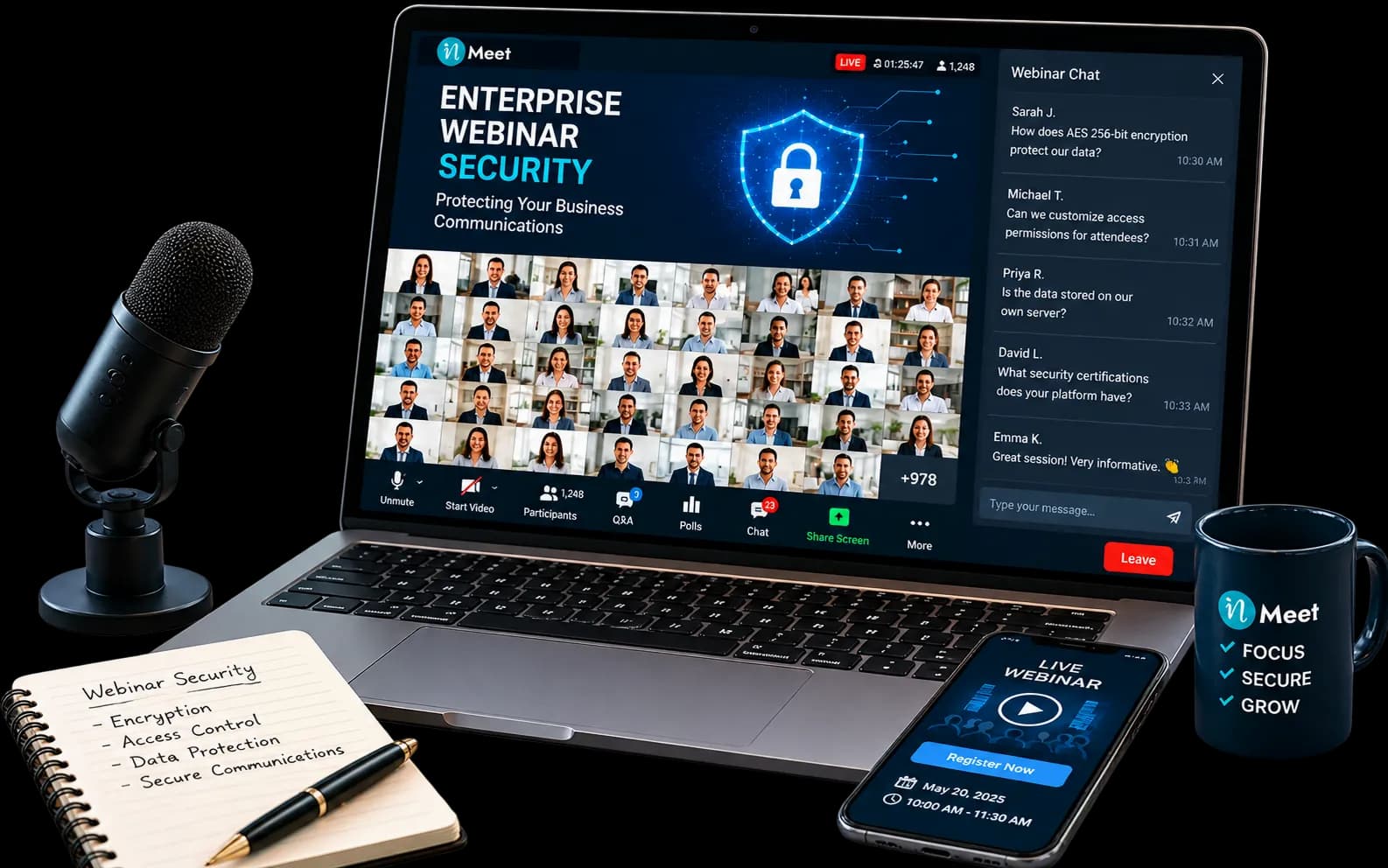
How to Protect Your Business Communications
June 30, 2026
AES 256-bit encryption scrambles every byte of your webinar data using a key so large it would take longer than the age of the universe to crack by brute force making it the gold standard for protecting confidential business communications on any webinar platform today
Think about what happens in a typical business webinar.
Your CFO walks the board through next year’s financials. Your legal team discusses a pending contract. Your HR director runs a benefits briefing with 400 employees across three time zones.
Every word. Every slide. Every chat message. All of it travels across the internet in real time.
Without enterprise-grade encryption, that data is exposed. Interceptable. Usable by anyone who gets between your signal and your attendees.
According to IBM’s Cost of a Data Breach Report 2024, the global average cost of a data breach hit a record $4.88 million — a 10% jump from the previous year and the largest single-year spike since the pandemic. A single leaked strategy call or intercepted product launch webinar can trigger legal liability, competitive damage, and serious reputational harm.
This is why the type of security your online webinar platform uses is not a checkbox. It is a business decision.
Want to see enterprise-grade webinar security in action? Book a personalized demo with inMeet to walk through exactly how your data is protected end to end.
AES stands for Advanced Encryption Standard. It is the encryption method used by the U.S. government to protect classified information and by banks to secure online transactions.
The 256-bit part refers to the length of the encryption key — the secret code used to lock and unlock your data.
Here is a simple way to think about it:
Even if every computer on Earth worked together for billions of years, they could not crack a properly implemented AES 256 key.
NIST (the National Institute of Standards and Technology) formally standardized AES under FIPS 197, first published in 2001 and updated in 2023. Since then, no one has broken AES 256 through a direct attack. It remains the encryption standard recommended by the NSA for top-secret information.
When your webinar platform advertises AES 256-bit encryption, it means your audio, video, screen shares, and chat are locked with military-grade security before they ever leave your device.
AES 256 is powerful, but it is only one layer of a truly secure webinar environment. Enterprise-grade platforms combine several security mechanisms together.
Here is what a full security stack looks like on a platform like inMeet Webinar:
| Security Feature | Why It Matters | AES 256-bit Encryption |
|---|---|---|
| AES 256-bit Encryption | Scrambles all data in transit | Makes intercepted data unreadable |
| Password Protection | Restricts meeting access | Blocks unauthorized attendees |
| Registration Approvals | Lets hosts approve each attendee | Prevents data leaks to unknown parties |
| Dedicated Subdomains | Each company gets its own environment | Isolates your data from other organizations |
| Firewall Traversal (ICE/WebSockets) | Maintains connectivity across NAT and proxies | Keeps sessions stable without opening security gaps |
| Host Engagement Controls | Hosts can mute/disable chat, polls, emojis | Prevents misuse during live sessions |
A webinar platform that only offers encryption but lacks registration controls or subdomain isolation leaves significant security gaps — especially for regulated industries like healthcare, finance, and government.
If you want to understand the full feature set that makes a webinar platform both secure and effortless to run, the inMeet Webinar features breaks down every capability in plain language.
Is your current webinar setup truly secure? Reach out to our experts for a free walkthrough of how inMeet handles security from the ground up.
Not every business faces the same level of risk. But almost every sector has compliance requirements that touch webinar communications directly.
Healthcare providers running patient briefings or training sessions must consider HIPAA compliance. Any video platform used for protected health information needs end-to-end encryption as a baseline.
Financial services companies are governed by frameworks like SOC 2, PCI-DSS, and SEC regulations. A single earnings call conducted over an unsecured platform can create regulatory exposure. The IBM 2024 report found healthcare and financial services organizations face the highest breach costs of any industry — healthcare averaging $9.77 million per incident.
Government and public sector organizations are often required to use platforms that meet FedRAMP or MEITY-certified standards. India’s Ministry of Electronics and Information Technology (MEITY) recognized InstaVC under its Innovation Challenge for Indian Video Conferencing Solutions in 2020.
Educational institutions handling student data must account for FERPA requirements in the U.S. and equivalent regulations in other countries.
The table below shows how security needs shift by sector:
| Sector | Key Compliance Framework | Critical Security Feature |
|---|---|---|
| Healthcare | HIPAA | End-to-end encryption, access controls |
| Financial Services | SOC 2, PCI-DSS | Audit logs, encrypted recordings |
| Government | FedRAMP / MEITY | Dedicated hosting, data sovereignty |
| Education | FERPA | Registration controls, host permissions |
| Corporate | GDPR, ISO 27001 | Password protection, attendee approvals |
Most companies focus on preventing external hackers. But some of the biggest webinar security risks come from inside the meeting itself.
For a deeper look at how modern webinar tools eliminate these friction points from the host side, read how inMeet makes hosting webinars effortless — it covers the full lifecycle from scheduling to post-event recording access.
Skip the manual security reviews. Book a personalized demo to see how inMeet handles all four of these risks out of the box.
Security claims are easy to make. Here is a practical checklist to verify them before committing to any online webinar platform:
If a vendor cannot answer all of these clearly and specifically, that is a signal worth taking seriously.
You may see some platforms advertising AES 128-bit encryption and wonder if it is meaningfully less secure.
| Feature | AES 128-bit | AES 256-bit |
|---|---|---|
| Key length | 128 bits | 256 bits |
| Possible key combinations | 3.4 × 10³⁸ | 1.1 × 10⁷⁷ |
| Current brute-force vulnerability | None known | None known |
| Recommended for classified data | No | Yes (NSA Suite B) |
| Processing overhead | Slightly lower | Slightly higher |
| Best for | General consumer apps | Enterprise / government use |
According to NIST’s FIPS 197 specification, AES-256 uses 14 encryption rounds compared to AES-128’s 10 rounds — giving it a significantly larger security margin against future computational threats, including theoretical quantum computing attacks.
In practical terms, both are currently unbreakable by any known method. However, for enterprise organizations, regulated industries, or any company where the cost of a breach is high, AES 256-bit is the right choice. It signals that the platform was built with serious security in mind from the ground up, not added as an afterthought.
Consider what happened when NDA, an AI-driven startup, needed to scale their virtual conference platform to support up to 200,000 participants in real time.
Their existing platform crashed under load. Socket handling in their backend was unstable. They had no infrastructure capable of isolating sessions or maintaining performance at that scale.
Working with inMeet’s team, they implemented:
This is the kind of scale inMeet Webinar is built for — backed by patented scalability technology that handles both massive audience size and airtight security simultaneously.
Security and scalability are not separate problems. They are the same problem. A platform that collapses under load is also a platform that cannot maintain encrypted sessions reliably under pressure.
Ready to run webinars at this scale — securely? Book a personalized demo and see exactly how inMeet handles 200,000 attendees without compromising on encryption or reliability.
AES 256-bit encryption is a method of securing data that uses a 256-bit key to encode all information transmitted during a webinar — including audio, video, screen sharing, and chat. It is the same standard used by the U.S. government for classified information and is currently unbreakable by any known attack method. NIST formally standardized it under FIPS 197.
Industries like healthcare, finance, and government operate under compliance frameworks (HIPAA, PCI-DSS, MEITY) that require specific data protection standards. According to IBM’s 2024 Cost of a Data Breach Report, healthcare organizations face average breach costs of $9.77 million per incident. A webinar platform without enterprise-grade encryption can expose your organization to regulatory fines, legal liability, and reputational damage.
Encryption in transit protects your data while it travels between devices during a live session. Encryption at rest protects stored recordings and session data when it is saved to a server. Enterprise webinar security requires both.
inMeet Webinar supports up to 200,000 attendees in a single session, backed by patented scalability technology and a multi-layer security architecture that maintains encrypted connections at every scale.
Have questions or need assistance? Fill out the form, and we'll get back to you right away!
Usually in 24 hours on working days.