Secure Video Meetings for Healthcare
What Clinics Need, What Most Platforms Miss
June 13, 2026
What Clinics Need, What Most Platforms Miss
June 13, 2026
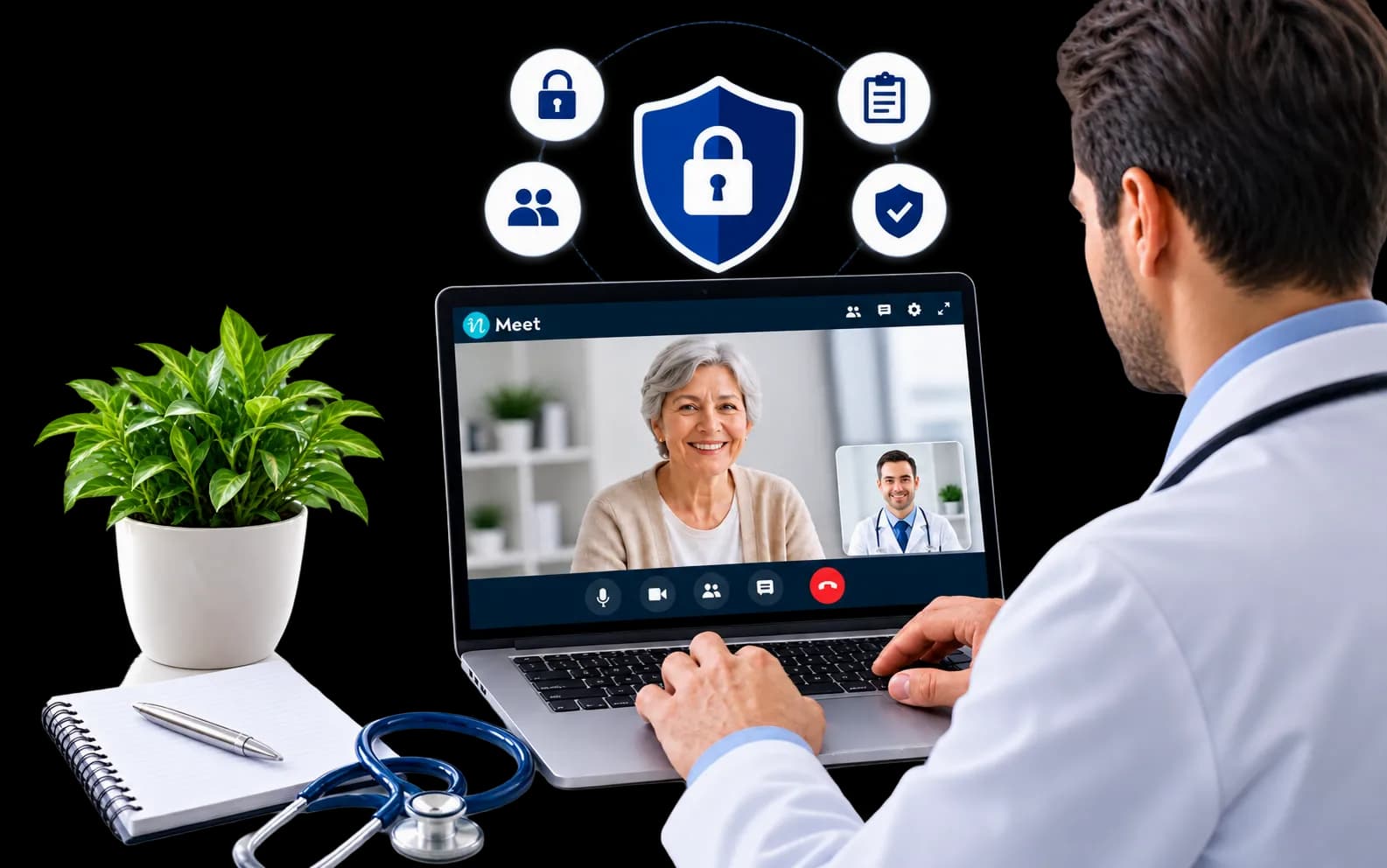
Virtual meeting software for healthcare is a secure, compliant video communication platform that lets providers conduct telehealth visits, care team huddles, and administrative meetings online — without compromising patient privacy or clinical workflow. The right platform reduces no-shows, cuts overhead costs, and expands patient access, especially in rural or underserved areas.
But not all platforms are built for clinical environments. This guide breaks down what makes a video meeting platform truly healthcare-grade, how inMeet by InstaVC delivers on those requirements, and what to evaluate before you commit.
Not every video call tool is built the same.
Zoom works fine for quarterly business reviews. But when a physician discusses a patient’s diagnosis, lab results, or treatment plan over a non-compliant platform, it can trigger federal HIPAA violations — with fines starting at $100 per incident and climbing to $1.9 million per year for repeated violations (HHS Office for Civil Rights). The AMA is explicit: physicians must comply with HIPAA and state privacy laws including when providing telehealth.
Healthcare organizations have needs that generic platforms were never designed to meet:
That is why purpose-built platforms like inMeet by InstaVC exist — and why healthcare-specific adoption has accelerated so sharply since virtual care became a clinical standard.
💡 Not sure if your current platform meets clinical requirements? Talk to an inMeet expert and get a free platform assessment.
Telehealth is no longer a niche feature. It is a standard of care — and the data reflects that shift.
Patients have adapted faster than most platforms have. The challenge now is not whether to use virtual meetings — it is choosing the platform that delivers them safely, effectively, and without compliance exposure.
📖 For the full clinical and operational case for a dedicated telehealth platform, read: 7 Strategic Advantages of Having a Dedicated Telehealth Video Platform.
Most buying guides list features without explaining why they matter clinically. Here is what actually counts.
HIPAA-Compliant Infrastructure — HIPAA compliance depends on configuration and contracts, not brand names. A vendor must operate within a compliant framework and provide documentation before you go live. Without this, video sessions carry legal exposure regardless of how secure the technology appears.
AES 256-Bit End-to-End Encryption — inMeet applies AES 256-bit encryption with multi-layer security architecture across all sessions, ensuring no third party — including the platform vendor — can intercept a patient conversation.
Private Virtual Waiting Rooms — Patients must never share a digital lobby. inMeet’s built-in waiting room lets providers admit each patient individually, preserving the confidentiality standard of a physical clinic.
EHR and EMR Integration — Native integrations with systems like Epic, Cerner, and Athenahealth let providers launch a visit directly from within the patient chart — no link-copying, no manual handoff.
Low-Bandwidth Performance — Not every patient has reliable broadband. inMeet is engineered with advanced bandwidth optimization, delivering stable video even at low connection speeds — critical for rural and elderly populations.
Compliant Recording and Audit Trails — inMeet supports local and cloud recording in WebM and MP4 formats, with comprehensive access logs retrievable on demand for compliance audits and continuity of care. Understanding HIPAA Compliance in Video Conferencing and Telehealth Platforms — Paubox
Virtual meeting software is not just for patient appointments. Here is where clinical teams use it every day.
Clinical: Telehealth follow-ups, medication reviews, chronic disease management, behavioral and mental health sessions, remote patient monitoring consultations, and specialist second opinions — all without requiring patient travel.
Administrative: Interdisciplinary care team rounds across departments and campuses, provider-to-provider e-consults for real-time specialist input, staff training and onboarding for distributed health systems, and board or compliance meetings with full audit trails.
Large-scale: For health systems running CME events or public health communications, inMeet’s built-in webinar module supports up to 200,000 attendees with YouTube Live Streaming, branded registration, speaker management, and real-time polls — no separate platform required.
📖 For teams managing remote and hybrid provider setups: How to Choose the Best Online Meeting Platform for Remote and Hybrid Teams.
| Feature | Generic Tools (Zoom, Teams) | inMeet |
|---|---|---|
| HIPAA Compliance | Requires configuration, not built-in | Enterprise-grade, built-in |
| End-to-End Encryption | Varies by plan | AES 256-bit, standard on all sessions |
| Video Quality | HD | 4K-ready for clinical-grade clarity |
| Licensing Model | Per-host, expensive at scale | Concurrent — saves up to 70% |
| Deployment Options | Cloud only | Cloud or on-premise |
A 20-provider clinic paying per-host for every provider account — whether those providers are in a session or not — pays for capacity it rarely uses. inMeet’s Concurrent Licensing charges only for simultaneous active sessions, which is how clinical operations actually work.
General tools can technically be configured toward HIPAA eligibility. inMeet is built compliant, clinical, and cost-efficient from day one. Is a Virtual Healthcare Platform Worth It for Hospitals? — InstaVC
Concurrent Licensing — Save Up to 70% inMeet’s Concurrent Licensing Model charges only for simultaneous active sessions — not per provider seat. For healthcare organizations where not every provider runs virtual sessions at the same time, this delivers up to 70% savings on annual recurring costs compared to traditional per-host models.
4K-Ready Video for Clinical Accuracy Observing a wound, a skin condition, a patient’s affect, or range of motion requires sharp, stable video. inMeet delivers 4K-ready video with HD audio clarity — giving providers the visual fidelity needed for informed clinical judgments during virtual visits.
AI-Generated Meeting Summaries After each session, inMeet automatically generates a structured summary capturing key discussion points, action items, and original and auto-corrected transcriptions. For every 30 minutes a provider spends with a patient, they spend 36 minutes charting (NCBI). AI summaries give providers a documentation starting point immediately after every visit — reducing after-hours charting and the burnout that comes with it.
Multi-Camera and Multi-Screen Support inMeet supports live feeds from up to 6 cameras simultaneously and allows up to 4 participants to share screens at the same time — valuable for procedure-based consultations, clinical training, and collaborative care reviews.
No-Download, Browser-Based Patient Join The most common reason patients abandon telehealth visits is login friction — forced app downloads, account creation, and confusing waiting room flows. inMeet is fully browser-based with no plugin or app required. Patients join via a single link on any device — Windows, iOS, Android, Linux, or macOS — in seconds.
White Labeling and On-Premise Deployment Healthcare organizations can deploy inMeet under their own brand — logo, colors, custom subdomain. And for health systems with strict data residency requirements, inMeet supports both cloud and on-premise deployment, giving full control over where patient session data lives.
� Skip the evaluation back-and-forth. Try inMeet free and see it in your clinical workflow today
Healthcare organizations often treat the platform decision as a technology line item. The actual cost calculus is clinical.
No-show rates average 18–23% across U.S. healthcare settings (Advisory Board). When the platform is difficult to join, that number climbs. Patients who cannot connect on the first attempt often skip the appointment entirely.
HIPAA breach settlements tied to technology misuse averaged $1.2 million (HHS). A non-compliant platform is not saving money — it is deferring a larger exposure.
Provider time lost to tech troubleshooting is clinical capacity consumed by an IT problem. When a clinician spends the first ten minutes of a virtual visit walking a patient through login steps, care has not started — but the clock has.
Choosing the right virtual meeting software is a clinical quality decision. With inMeet’s AI summaries, concurrent licensing, and zero-friction patient join, ROI shows up in reduced no-shows, lower compliance risk, and recovered provider time — from the first month.
For behavioral health practices especially, where therapeutic continuity matters deeply, a platform that drops mid-session or pushes patients through a confusing join process does not just create an IT ticket — it damages the clinical relationship. The platform is part of the care experience, whether clinicians think of it that way or not.
Not every clinic has the same priorities. A solo behavioral health therapist needs something different from a 500-bed hospital system.
Small and solo practices benefit most from inMeet’s simple browser-based join, instant meeting capability, calendar integration, and concurrent pricing that does not charge for idle provider accounts. There is no IT department required to set it up or maintain it.
Community health centers and FQHCs serving underserved populations need bandwidth optimization for low-connectivity patients and multi-language support — both standard in inMeet — alongside a licensing model that does not scale costs faster than patient volume.
Hospital systems and multi-campus networks need EHR integration at scale, single sign-on for providers, centralized admin dashboards, and Multi Display Telepresence for coordinating care across buildings and campuses. inMeet’s auto-scalable backend MCU handles demand spikes without manual infrastructure adjustments.
Behavioral health and mental health practices need a calm, discreet patient-facing interface, strong waiting room privacy, screen sharing for CBT worksheets and clinical tools, and AI-generated summaries that capture session notes without adding charting time at the end of a long clinical day.
Virtual care is no longer a backup option — it is how modern clinical teams operate. But the platform underneath that care either protects your patients, your providers, and your compliance standing, or it quietly works against all three.
Generic tools were built for boardrooms. inMeet was built for clinics — with the encryption, waiting room privacy, EHR integration, AI documentation, and licensing model that healthcare organizations actually need.
The right platform does not just host a video call. It reduces no-shows, cuts documentation burden, keeps your team compliant, and gives patients a join experience so simple they never have to call the front desk for help.
That is the difference between a video tool and a clinical communication platform.
inMeet is a cloud-based SaaS video meeting platform by InstaVC, purpose-built for healthcare. Clinics use it for telehealth visits, care team coordination, provider-to-provider e-consults, staff training, and large-scale CME webinars — all on one secure, browser-based platform with AES 256-bit encryption and AI-generated session summaries.
Patients receive a link and join through any standard web browser — no app download, no account creation, no plugin. Works on any device and operating system including smartphones, tablets, and desktops.
Most platforms charge per host whether that provider is in a meeting or not. inMeet charges only for simultaneous active sessions — reducing annual licensing costs by up to 70% for clinics where providers are not all online at the same time.
Yes. inMeet supports both cloud and on-premise deployment, giving health systems with strict data residency requirements full flexibility over where patient session data is stored and processed.
Have questions or need assistance? Fill out the form, and we'll get back to you right away!
Usually in 24 hours on working days.